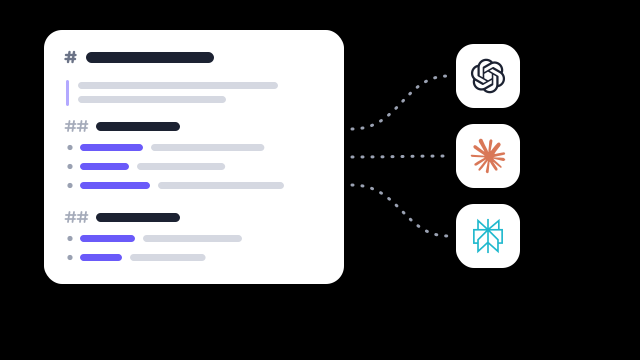
The short answer. llms.txt is a plain markdown file at yoursite.com/llms.txt with your company’s name, a one-paragraph summary and a list of links to your key pages. It was proposed at llmstxt.org in September 2024 so that a model, or an agent working for someone, can understand a site without wading through navigation and scripts. It’s worth twenty minutes. No major assistant has said it reads yours when answering a buyer’s question, so don’t expect it to change what they say.
The format
The spec is short, and the order matters:
- An H1 with the name of the site. The only required part.
- A blockquote summary. One paragraph with the facts a reader needs for the rest of the file.
- Detail, optional. Paragraphs or lists with no headings.
- H2 sections of links. Each item is
- [name](url): notes. A section called Optional holds links a reader can skip when it needs a shorter context.
# Northwind CRM

> Northwind is a CRM for B2B sales teams of 10 to 200 reps. Plans start
> at $25 per seat per month. It integrates with Gmail, Outlook and Slack.

Northwind is sold self-serve. There is no free plan; there is a 14-day trial.

## Product

- [Pricing](https://northwind.example.com/pricing): plans, limits and what each includes
- [Integrations](https://northwind.example.com/integrations): every supported tool
- [Security](https://northwind.example.com/security): SOC 2 report and data handling

## Optional

- [Changelog](https://northwind.example.com/changelog)
Northwind is a made-up company. Our own file is at mentioned.at/llms.txt if you want a real one.
Who reads it today
The clearest audience is developer tools and coding agents. Documentation sites, including OpenAI’s, Anthropic’s and Perplexity’s, publish an llms.txt, and Perplexity’s docs point AI agents to theirs by name.
The assistants your buyers use are a different matter. As of October 2026, the crawler documentation from OpenAI, Anthropic, Perplexity and Google doesn’t say their assistants read a site’s llms.txt when answering a question, and Google’s guidance for AI Overviews doesn’t mention it. That may change. Until an operator says so, treat llms.txt as a good summary in a convenient place, not a ranking signal.
What to put in yours
- The facts assistants get wrong about you. Who you sell to, what you cost, what you integrate with, whether there’s a free plan. Concrete beats positioning: “CRM for B2B sales teams of 10 to 200 reps” is a fact; “the revenue platform for modern teams” isn’t.
- Links to pages that answer buyer questions. Pricing, comparisons, integrations, security, and the guides that explain your category. Not your blog archive.
- Notes on each link, saying what the page answers, so a reader can choose without opening it.
- Absolute URLs. A relative link breaks when the file is read on its own.
Then serve it as text/plain or text/markdown, and check that /llms.txt actually returns the file. Many sites answer any unknown path with their homepage, which means there is no llms.txt at all. The llms.txt validator checks a live file or a pasted one line by line, and can generate one from a list of pages.
What matters more
An llms.txt can’t help if crawlers can’t reach your site, and it can’t outweigh what the rest of the web says about you. In order:
- Make sure the search crawlers can read your pages. See AI crawlers and robots.txt.
- Make sure the pages say the facts plainly, in the HTML, not only after JavaScript runs.
- Find out which buyer questions you’re missing from, and who gets named instead. That’s where the work is.
Questions
Is llms.txt the same as robots.txt?
No. robots.txt tells crawlers what they may fetch. llms.txt doesn’t allow or block anything: it’s a short markdown summary of a site with links to its most useful pages, written for a language model to read.
Does Google use llms.txt?
Google doesn’t list it among the controls for AI Overviews and AI Mode, which it says follow the same rules as Search. Google’s own developer site doesn’t publish one either.
Where does the file go?
At the root of the site, as /llms.txt, served as plain text. The format also allows one at a subpath, such as /docs/llms.txt, covering the pages under it.
How long should it be?
Short enough to read in one pass. It’s an index, not a copy of your site. If you want to give a model the full text of your key pages, put that in a separate llms-full.txt and link to it from the Optional section.
Run a free check Validate your llms.txt →